
If you love your neighbourhood but your house no longer fits the way you live, the biggest question is often not what finishes to choose. It is whether the home is still worth renovating at all.
For many Toronto homeowners, that decision sits right at the edge of two very different paths. One is a major renovation that keeps the existing structure and upgrades what is there. The other is a tear-down and rebuild that gives you a fresh start on the same lot.
Both can be the right choice. Both can also become expensive mistakes when the decision is made too early, based on the wrong priorities, or without a clear understanding of what the property can realistically support. In Toronto, permits, zoning, demolition rules, and heritage controls can shape the outcome just as much as design preferences do.
Start with the Real Question
Most homeowners begin by asking, “Is it cheaper to renovate or rebuild?”
Cost matters, but it is usually not the only question that decides the project.
A better starting point is this:
Are you trying to improve the home you have, or are you trying to create a completely different home on the same property?
That distinction matters because renovations work best when the existing house still gives you something worth building around. A rebuild makes more sense when the structure, layout, ceiling heights, energy performance, or long-term limitations are so significant that you would spend heavily just to end up with a compromised result.
In other words, the smartest decision is not always the lower initial number. It is often the path that gives you the better long-term fit.
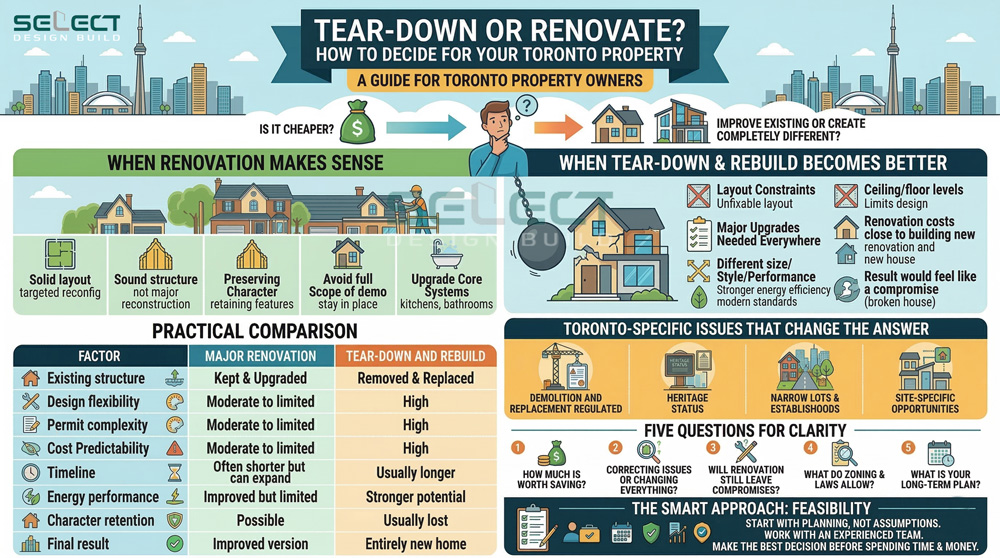
When Renovating Usually Makes More Sense
Renovation is often the stronger option when the house already has good fundamentals and the changes you want are substantial, but still workable within the existing structure.
That may include situations like these:
- The home has a solid layout that only needs targeted reconfiguration
- You want to upgrade kitchens, bathrooms, finishes, and core systems
- The structure is sound and does not require major reconstruction
- You want to preserve character features that matter to you
- The lot or neighbourhood makes a rebuild less practical
- You want to stay in place and avoid the full scope of demolition and new-home approvals
A major renovation can still be complex. It may involve structural changes, additions, underpinning, permit coordination, and a full interior rework. But if the existing house has enough value to build on, renovation can be the more efficient way to improve daily function and resale potential without starting from zero.
This is often the right path for homeowners whose main goal is to make the house work better, not to replace it completely.
When a Tear-Down and Rebuild Becomes the Better Option
A rebuild starts to make more sense when the existing house is creating too many constraints.
That might mean:
- The layout cannot be fixed without extensive structural work
- Ceiling heights, floor levels, or framing conditions limit design options
- The house needs major upgrades in almost every area
- You want a very different size, style, or performance standard
- Energy efficiency and modern building standards are a priority
- Renovation costs are climbing close to the cost of building new
- The end result of a renovation would still feel like a compromise
For some Toronto properties, especially older houses with poor layouts or repeated piecemeal alterations over time, renovation becomes a long list of workarounds. A rebuild can offer cleaner design freedom, more predictable sequencing, and better long-term performance if the site and approvals support it.
That does not automatically make rebuilding easier. It usually means a larger commitment, a longer timeline, and more approvals. But in the right situation, it can be the more rational investment.
The Decision Is Not Only About Budget
Homeowners often compare renovation and rebuild as if it is a straight price check.
It rarely works that way in practice.
A renovation budget can look smaller at the beginning, but older homes often reveal hidden conditions once walls and floors are opened. Structural deficiencies, outdated services, water damage, poor insulation, and previous unpermitted work can all expand scope after construction starts.
A rebuild can cost more upfront, but it may reduce the amount of compromise and reactive decision-making later. It also gives you the chance to design the home around how you actually want to live now, rather than forcing a new plan into an old shell.
Here is a practical comparison:
| Factor | Major Renovation | Tear-Down and Rebuild |
|---|---|---|
| Existing structure | Kept and upgraded | Removed and replaced |
| Design flexibility | Moderate to limited | High |
| Permit complexity | Moderate to high | High |
| Hidden-condition risk | Higher | Lower once demolition is complete |
| Timeline | Often shorter, but can expand | Usually longer |
| Energy performance | Improved, but limited by existing structure | Stronger long-term potential |
| Character retention | Possible | Usually lost unless intentionally recreated |
| Final result | Improved version of the same house | Entirely new home |
The point is not that one is always better. It is that they solve different problems.
Toronto-Specific Issues That Can Change the Answer
This decision is more local than many homeowners expect.
In Toronto, project feasibility is shaped by zoning, permits, neighbourhood context, and sometimes heritage controls.
A few examples:
1. Demolition and Replacement Are Regulated
Demolishing a residential building in Toronto generally requires a demolition permit, and replacement-building projects have their own submission requirements.
2. Heritage Status Can Significantly Affect the Path
If the property is designated or located in a Heritage Conservation District, proposed alteration or demolition may also require heritage review through the City’s process.
3. Narrow Lots and Established Neighbourhoods Affect Logistics
Even when a project is technically possible, access, staging, deliveries, tree protection, and neighbouring homes can change the cost and complexity of both renovation and rebuild work.
4. Site-Specific Opportunities May Shift the Strategy
Some properties are better suited for additions, while others may have potential for a more complete transformation through a new custom home. Some lots may also support future secondary structures, depending on location and compliance.
This is why the decision should start with property analysis, not assumptions.
Five Questions That Help Make the Right Call
If you are stuck between renovation and rebuild, these are usually the questions that clarify the path.
1. How Much of the Existing House Is Actually Worth Saving?
If the answer is “not much beyond the location,” rebuilding may deserve serious consideration.
2. Are You Trying to Correct a Few Major Issues or Change Almost Everything?
If the project touches layout, structure, mechanical systems, envelope performance, and additions all at once, you may be approaching rebuild territory even if you have not called it that yet.
3. Will Renovation Still Leave You With Compromises You Do Not Want?
This is one of the most overlooked questions. A renovation can be expensive and still leave you with low ceilings, awkward circulation, or structural limitations.
4. What Does the Property Legally and Physically Allow?
You need to understand setbacks, lot conditions, zoning limits, demolition requirements, and any heritage concerns before deciding which option is realistic.
5. What Is Your Long-Term Plan for the Property?
If this is your long-term family home, rebuilding may be easier to justify. If you expect to move sooner, a well-planned renovation may provide the right level of improvement without taking on a full new-build scope.
Why Homeowners Get This Decision Wrong
The most common mistake is treating the choice as a design decision instead of a planning decision.
People often commit emotionally to renovation because it feels less disruptive, or to rebuilding because it feels like a cleaner dream outcome. But neither path should be chosen before the property has been reviewed properly.
Another common mistake is comparing numbers that are not truly comparable. A superficial renovation estimate and a fully custom new-home vision are not measuring the same thing. The right comparison has to look at scope, limitations, permit implications, and the quality of the final outcome.
This is also where working with a team that understands both sides matters. If you only explore renovation, you may never test whether a rebuild would actually make more sense. If you only pursue a new build idea, you may overlook a renovation strategy that gives you what you need with less disruption.
That is why early planning matters so much. On projects where homeowners are deciding between a major renovation and a fresh build, a structured review can save months of uncertainty and a lot of avoidable design work. For some properties, the next step is a major renovation through our residential construction and renovation service. For others, the better long-term move is a fully new home through our custom home building service.
A Practical Way to Move Forward
If you are unsure which direction is right, do not start by choosing finishes or sketching a dream layout.
Start with a feasibility conversation around:
- the existing house condition
- the lot and zoning context
- the scope of change you actually want
- the approval path
- the likely level of structural intervention
- the long-term value of each option
That process tends to reveal whether you are working with a good candidate for renovation or a property that would benefit more from a full reset.
The goal is not to force every project toward a custom build. The goal is to make the right decision before you spend time and money developing the wrong one.
Final Thought
For Toronto homeowners, tear-down versus renovation is rarely a simple yes-or-no question. It is a property question, a planning question, and a lifestyle question at the same time.
Renovation makes sense when the home still gives you a strong base to work from and the improvements can solve the real problems. A rebuild makes sense when the existing house is holding the property back and a fresh start would deliver a better long-term result.
The smartest first step is not committing to one path too early. It is understanding what your property can support and which option gives you the better outcome once permits, structure, design freedom, and long-term use are considered together.