
Here’s the short answer: in most of Toronto, you can legally add up to four units, duplex, triplex, or fourplex, without a rezoning application, while a sixplex is only allowed as-of-right in nine specific wards. Duplex vs Triplex vs Fourplex vs Sixplex Toronto really comes down to which ward your lot sits in and how the bedroom rules apply to your design. At Select Design Build, we help homeowners across Toronto figure out exactly what their property qualifies for before they spend a dollar on drawings. Here’s how it breaks down.
Duplex vs Triplex vs Fourplex vs Sixplex Toronto: Side-by-Side Comparison
| Type | Units | Where It’s Legal | Parking Required | Max Bedrooms | Typical Conversion Cost | Typical Timeline |
|---|---|---|---|---|---|---|
| Duplex | 2 | City-wide, as-of-right | None | 8 total | $150,000 to $250,000 | 4 to 6 months |
| Triplex | 3 | City-wide, as-of-right | None | 9 total | $200,000 to $350,000 | 5 to 7 months |
| Fourplex | 4 | City-wide, as-of-right | None | 12 total | $250,000 to $450,000+ | 6 to 8 months (new build: 12 to 16 months) |
| Sixplex | 5 to 6 | Nine wards only, as-of-right | None | 15 to 18 total | $400,000 to $600,000+ | 16 to 20 months (mostly new build) |
Duplex, triplex, and fourplex projects follow the same rulebook everywhere in Toronto, so the real decision usually comes down to budget and how much rental income you actually need. A sixplex is a different animal. It’s only automatic in specific wards, it almost always means new construction rather than a simple conversion, and the jump in cost and timeline reflects that. Where a project lands on this Duplex vs Triplex vs Fourplex vs Sixplex Toronto spectrum depends less on what you want and more on what your lot and ward actually allow, which is exactly what the next sections walk through.
Is a Sixplex Legal on My Property? The Nine-Ward Rule Explained
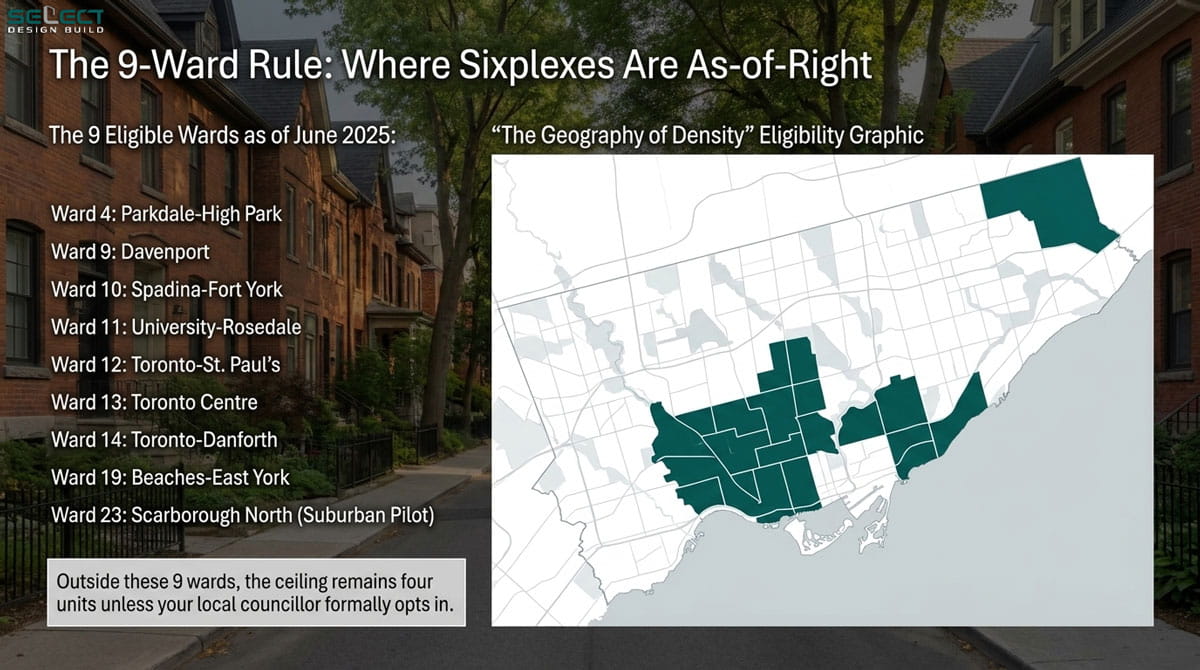
Not every part of Toronto plays by the same rules once you cross from four units into five or six. As of June 2025, sixplexes are as-of-right in only nine wards under OPA 818 and Zoning By-law 654-2025:
- Ward 4, Parkdale-High Park
- Ward 9, Davenport
- Ward 10, Spadina-Fort York
- Ward 11, University-Rosedale
- Ward 12, Toronto-St. Paul’s
- Ward 13, Toronto Centre
- Ward 14, Toronto-Danforth
- Ward 19, Beaches-East York
- Ward 23, Scarborough North (added as a suburban pilot)
Outside these nine, the as-of-right ceiling stays at four units, no matter how big your lot is. A ward can still opt in through its councillor, so it’s worth checking the current status before you design around six units. Which zone your property falls under (R, RD, RS, RM, or RT) also affects what’s actually buildable on your lot, which is a separate question worth confirming alongside your ward.
If your address sits outside the nine wards, a sixplex isn’t off the table forever, but it means either waiting on an opt-in or applying for a rezoning, which adds time, cost, and no guarantee of approval. For most homeowners outside those wards, a fourplex remains the practical ceiling.
Bedroom Limits and Other Rules You Can’t Ignore
Toronto doesn’t just cap the number of units, it caps the number of bedrooms too, and this catches a lot of homeowners off guard mid-design.
| Building Type | Bedroom Formula | Maximum Bedrooms |
|---|---|---|
| Duplex | Up to 4 per unit | 8 total |
| Triplex | 3 per unit average | 9 total |
| Fourplex | 3 per unit average | 12 total |
| Fiveplex | 3 per unit average | 15 total |
| Sixplex | 3 per unit average | 18 total |
The bedroom cap exists to stop multiplexes from becoming disguised rooming houses. A fourplex with four three-bedroom units is fine; two units with five bedrooms each to pack in more tenants is not, even if the square footage allows it.
A few other rules matter too. Building length can reach 19.0 metres on deep lots (36+ metre depth with under 10 metre frontage, or 40+ metre depth with 10+ metre frontage). Lot coverage, setbacks, and a height overlay (commonly 10 metres) still apply, with sixplexes capped at four storeys where they’re permitted. One rule works in your favour: the floor space index that limits a typical house doesn’t apply to a multiplex, which is part of why four units can fit on a lot built for one.
How Much Does Each Option Cost in Toronto?
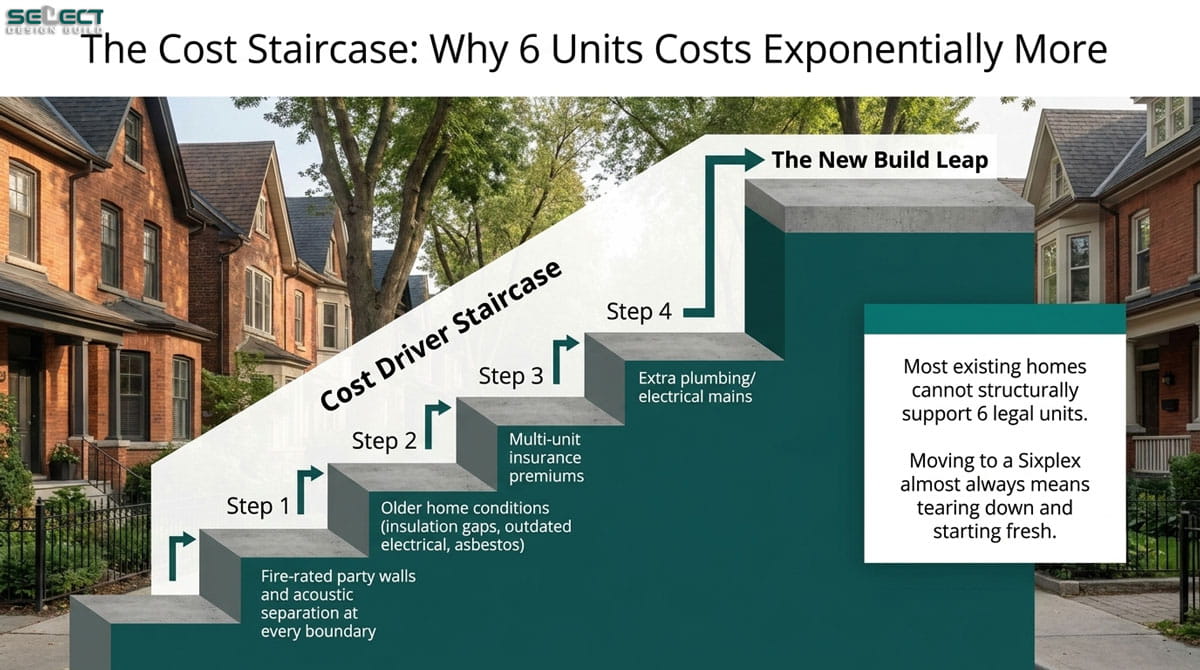
Cost climbs with each unit you add, but not evenly. A duplex is the cheapest route since it usually just splits an existing house. A triplex and fourplex add cost through extra plumbing, electrical work, and fire separation at each unit boundary. A sixplex sits apart entirely, since most existing houses can’t structurally support six legal units, so it’s almost always new construction, which costs far more than a conversion.
A few things drive the price regardless of unit count:
- Fire-rated party walls and acoustic separation required at every unit boundary, no matter the building size
- Older home conditions like outdated electrical, insulation gaps, or asbestos, which affect conversions specifically
- Insurance, which runs noticeably higher for a multi-unit building than a single-family home, and needs to be disclosed at occupancy
- Development charges, which Toronto currently waives for multiplex projects up to six units, a savings that can meaningfully offset the added cost of going from four units to five
That last point is worth paying attention to. The development charge waiver can be worth more than the extra construction cost of adding a fifth unit, which is part of why the math on a fiveplex sometimes works out better than owners expect.
Exact budget numbers shift often enough with material costs and permit fees that they’re worth pulling from a source built specifically to stay current, we keep a full breakdown of current build and conversion costs by unit count in our Cost of Multiplex Conversion in Toronto.
Rebates and Financial Incentives That Can Offset the Cost
Toronto waives development charges and parkland fees entirely for multiplex projects up to six units, and in June 2026 the city locked in $1.5 billion in federal and provincial funding to keep those exemptions in place. This isn’t a short-term deal, it’s where the policy is heading.
Financing helps most on five and six-unit projects. CMHC MLI Select insures multiplex mortgages with up to 95% loan-to-value and amortizations up to 50 years, with reduced premiums for projects meeting certain affordability or energy targets. GST/HST rebates also apply to purpose-built rental housing, which can cover a legally converted multiplex held as a rental.
Premiums did rise in July 2025, so savings aren’t as steep as before, but this financing still beats conventional lending for most fourplex, fiveplex, and sixplex projects. Worth confirming eligibility with a mortgage broker before assuming it applies.
How to Decide Which Option Is Right for Your Property
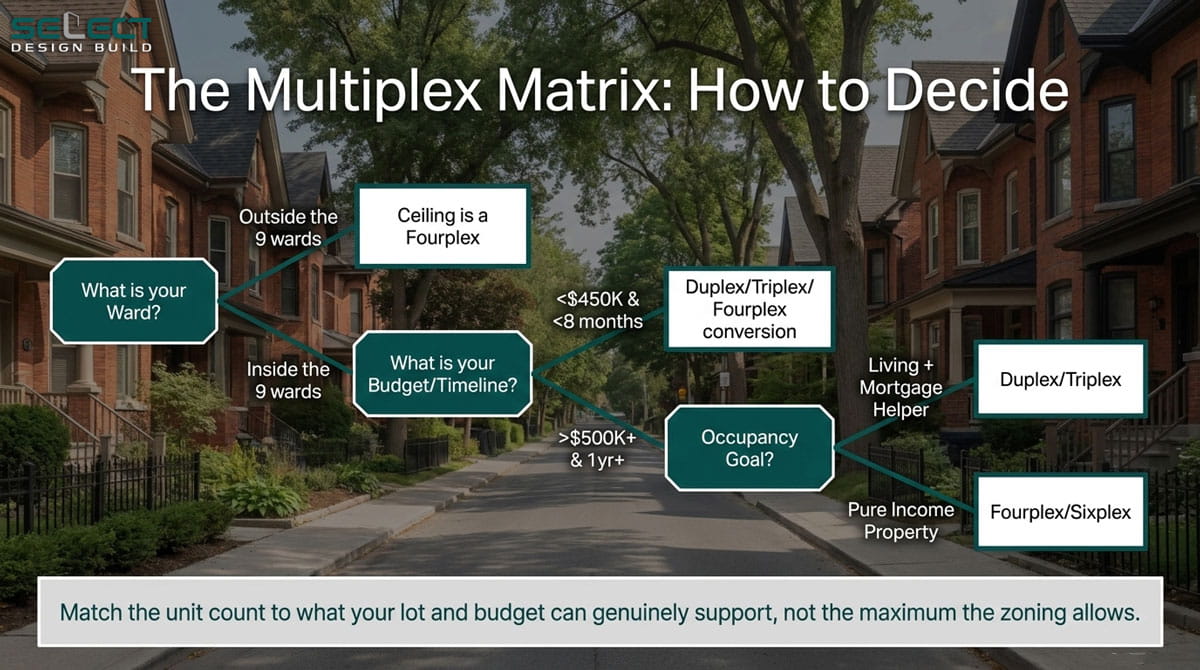
The right choice usually comes down to three questions, not personal preference:
- What’s your ward? If you’re outside the nine sixplex wards, your realistic ceiling is a fourplex, full stop.
- What’s your budget and timeline tolerance? A duplex or triplex conversion can be done in months on a modest budget. A sixplex is a year-plus commitment with new-build costs to match.
- Are you living in it or renting it out? A duplex often works well if you want a mortgage helper while still living in part of the house. A fourplex or sixplex makes more sense as a pure income property, especially with CMHC financing in play.
A good rule of thumb: match the unit count to what your lot and budget can genuinely support, not to the maximum the zoning allows. A fourplex that’s tight and poorly laid out rents worse and costs more per unit than a well-designed triplex on the same lot.
Can I build a fiveplex in Toronto?
Yes, but only in the same nine wards where sixplexes are permitted as-of-right. A fiveplex sits under the same bylaw as a sixplex (OPA 818 and Zoning By-law 654-2025), just with one fewer unit, and it’s often the more practical choice since it avoids the fourth-storey design that a full sixplex sometimes requires. Outside those nine wards, a fiveplex isn’t automatic and would need a rezoning application like a sixplex would.
Is a sixplex legal everywhere in Toronto?
No. This is the most common misunderstanding homeowners have about Toronto’s multiplex rules. A sixplex is only as-of-right in nine wards, adopted through OPA 818 and Zoning By-law 654-2025 in June 2025: Parkdale-High Park, Davenport, Spadina-Fort York, University-Rosedale, Toronto-St. Paul’s, Toronto Centre, Toronto-Danforth, Beaches-East York, and Scarborough North as a suburban pilot.
Everywhere else in the city, the as-of-right maximum stays at four units. Other wards can still opt in through their local councillor, so it’s worth checking current status before assuming your property qualifies. Building a sixplex outside the nine wards isn’t impossible, but it means going through a rezoning application rather than a straightforward building permit, which adds significant time and no guarantee of approval.
Conclusion
Deciding between a Duplex vs Triplex vs Fourplex vs Sixplex Toronto isn’t really about preference, it’s about what your ward, lot, and budget actually allow, and getting that assessment wrong before you start drawings is the most expensive mistake a homeowner can make. If you’re ready to find out exactly what your property qualifies for, Select Design Build’s Multiplex Conversions team can walk your lot through zoning, permits, and cost before you commit to a design.